1000 questions · Free · Certificate on completion
The Great Mahabharata Quiz
The greatest epic ever.
And the biggest, baddest quiz.
How it works
Five at a time.
A round is five questions
Four options, thirty seconds each. Two or three minutes, then stop whenever you like — it picks up exactly where you left off, on any device.
Wrong answers come back
Answer one correctly and it leaves your pile for good. Get it wrong and it returns in a later round, until you get it.
Finish the pile, take the certificate
Every question in your pile, answered correctly. Then a PDF with your name on it. There is no other way to get one.
Beyond the battle
The war takes five of the eighteen books. The rest is where the epic lives.
A house of lac built to burn at Varanavata. A forest on the mountain Gandhamadana, where Bhima meets Hanuman and cannot lift his tail. A snake sacrifice held to avenge a king killed by Takshaka — and it is at that fire that the whole poem is recited to us. Bhishma on a bed of arrows, answering questions on dharma for two entire books.
How much of it do you know?
Try one
This is the easy end.
Who created a lifelike image of Dronacharya in clay and practised archery before it?
Show the answer
Ekalavya.
Try one more
This is the deep end.
What is Kurukshetra also known as?
Show the answer
Samantapanchaka.
Nine hundred and ninety-eight more where those came from.
Want the answers first? Read 25 tough Mahabharata questions, with answers.
Before the certificate
The first rank is twenty-five correct answers away.
- Yodha 25 correct
- Ratha 100 correct
- Maharatha 300 correct
- Atiratha 1000 correct
Ranks arrive as you go. The first is Yodha (warrior); the last is Atiratha (unrivalled warrior).
The certificate
A PDF with your name on it.
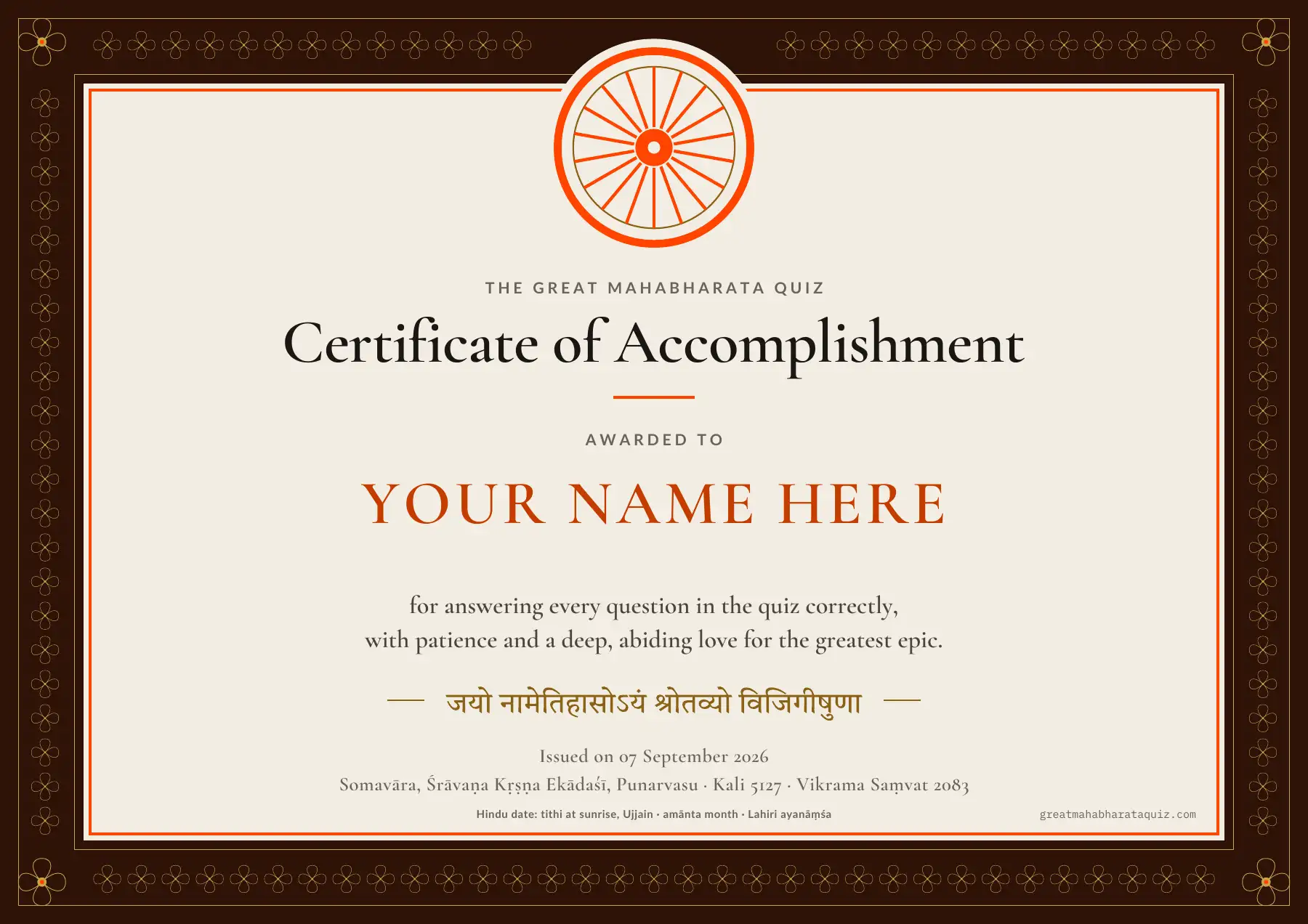
You type the name you want on it, and it is yours to download and keep. You didn't quit, and you conquered every single one of the 1000 questions. Be proud of it.
They got to the end
Every question, answered correctly.
The questions
Where the answers come from.
The questions are written and checked against the Critical Edition — the text reconstructed at the Bhandarkar Oriental Research Institute. Wherever the epic is disputed, that is the standard this quiz is held to. Where the fuller tradition carries episodes the Critical Edition leaves out, those are checked against the complete text instead. Every question was verified before it went in.
Questions come from all eighteen parvas, the eighteen books of the epic. That includes the Shanti and Anushasana parvas, where the dying Bhishma teaches Samkhya philosophy and dharma. It includes the four short books after the war, which most retellings never reach. The Bhagavad Gita is included.
Answers follow the Sanskrit epic, not the television serials or the regional retellings. Both are wonderful. Neither is what this quiz asks about.
Read
The stories behind the questions.
Sunda and Upasunda: two asuras whom nothing could kill except each other.
The eighteen days of Kurukshetra: who led the Kauravas on each day, and what happened.
Who narrated the Mahabharata? Vyasa, Vaishampayana, Ugrashrava and Sanjaya.
Install it
Take the quiz with you.
Add it to your home screen and it opens like any other app — full screen, no browser bar, one tap from wherever you keep it.
It keeps working offline
Questions already on your device keep working without a connection. Your score syncs the moment you reconnect.
No app store, no download
Your browser adds it in one step. There is no app store account to create and nothing to uninstall — drag the icon off your home screen and it is gone.
Your progress follows your account
Answer on your phone, carry on at your desk. Progress lives with your Google sign-in, not with the device.
iPhone & iPad
Tap Share, then Add to Home Screen.
Android & Chrome
Tap Install when the prompt appears, or pick Add to Home screen from the browser menu.
Before you ask
- Is it really free?
- Yes. There is nothing to buy, no trial, and no card.
- Why do I have to sign in?
- So your progress survives a closed tab. Google only tells us your name and email address, nothing else.
- How long does it take?
- As long as you like. There is no deadline. Five questions a day or fifty. Want a daily habit? Try Power of One: only one question a day. And you get to complete the massive epic, bit by bit. No email or sign-up required.
- Can I get the certificate twice?
- No. It is issued once, with the name you type, so type it carefully.
What are you waiting for?
Shubhasya shighram — the good thing, without delay.